Vapour blasting may be suitable for many aluminium engine cases, covers and castings after the component, condition and sensitive areas have been assessed. However, it should not be described as automatically safe for every aluminium part, assembled component or precision surface.
Material, condition, geometry, internal passages, machined areas and the required finish all matter. The part must also arrive fully stripped and ready to go straight into the blaster. VMC therefore assesses photographs before accepting a job or confirming a price.
View VMC aluminium engine-part blasting →
Why vapour blasting is used for aluminium
Vapour blasting—also called wet blasting or aqua blasting—uses water, fine abrasive media and compressed air. The process suspends fine abrasive media in water and is commonly selected to produce a controlled satin finish on suitable components.
Compared with an unsuitable or overly aggressive dry-blasting process, a correctly selected wet process can offer more controlled surface treatment. It is still abrasive and must be matched to the component. It may be useful for suitable:
- Engine cases and crankcases
- Rocker, clutch and timing covers
- Carburettor bodies
- Cylinder heads
- Gearbox casings
- Manifolds
- Motorcycle and classic-car castings
“Gentler” does not mean “risk free.” Correct assessment and process selection remain essential.
View VMC's vapour and wet blasting service →
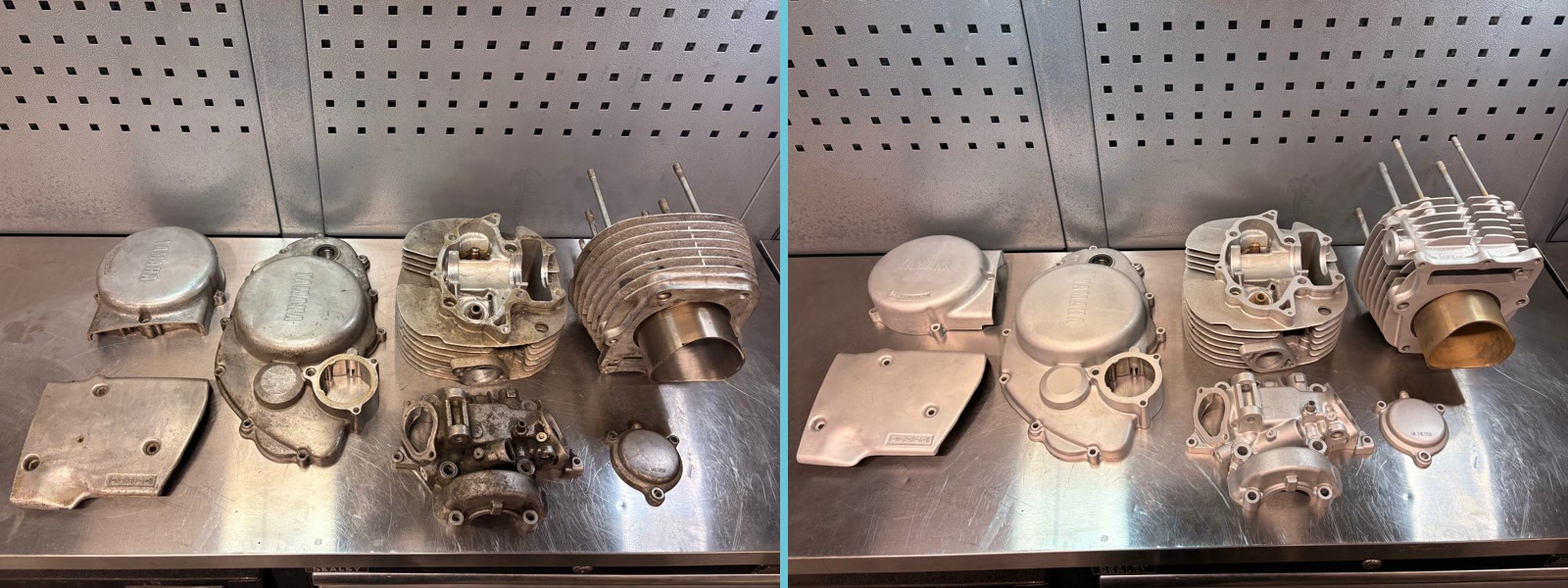
Real VMC example: Yamaha motorcycle engine castings
This disassembled group includes Yamaha-branded motorcycle engine covers and castings, a finned cylinder-head casting, a finned cylinder or barrel and other engine housings. The photographs do not establish a particular motorcycle model, year or engine capacity.
Before vapour blasting
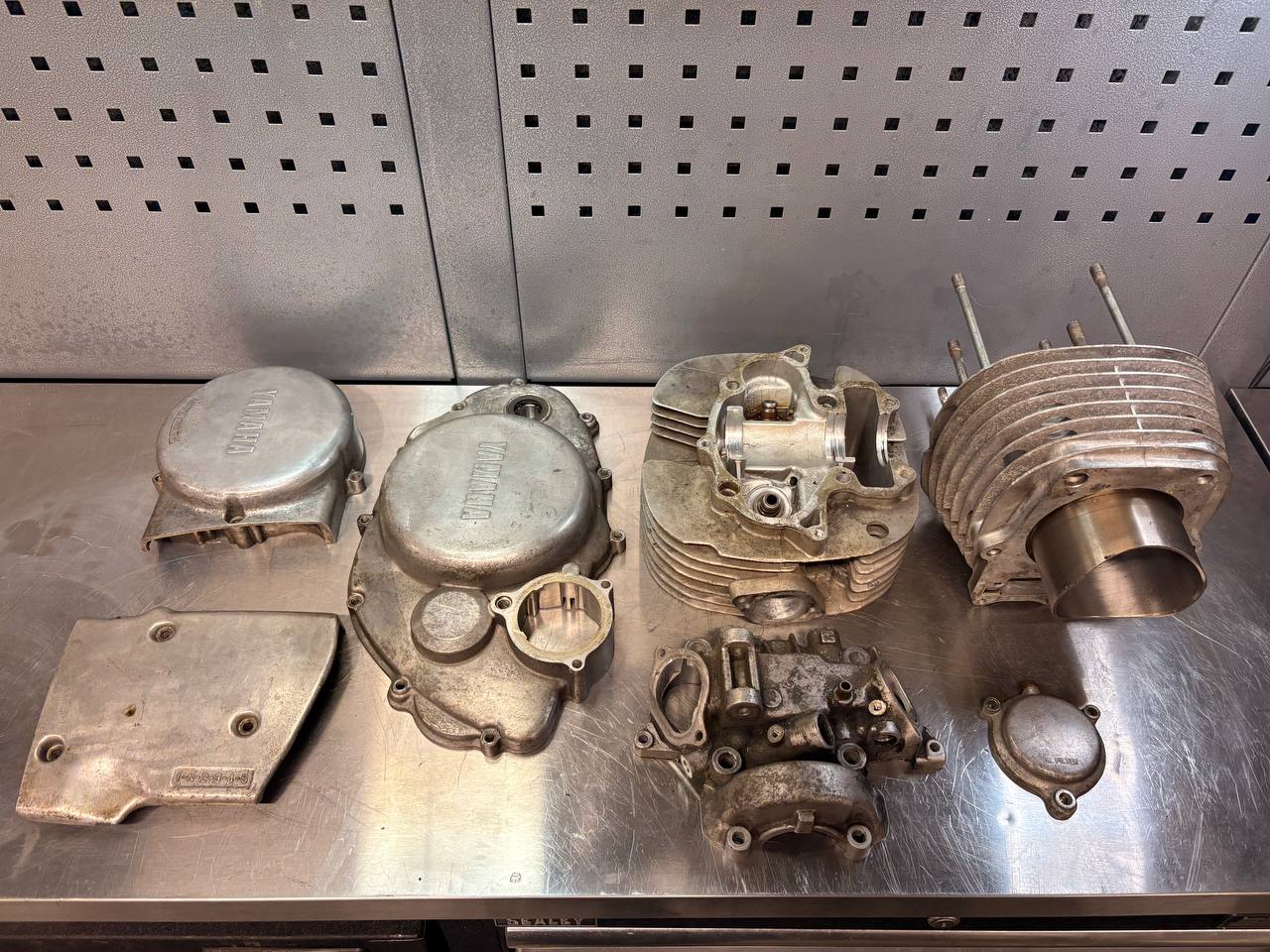
Before: the aluminium castings had a dull, uneven appearance with grime, staining and visible surface oxidation across the covers, housings and cooling fins.
After vapour blasting
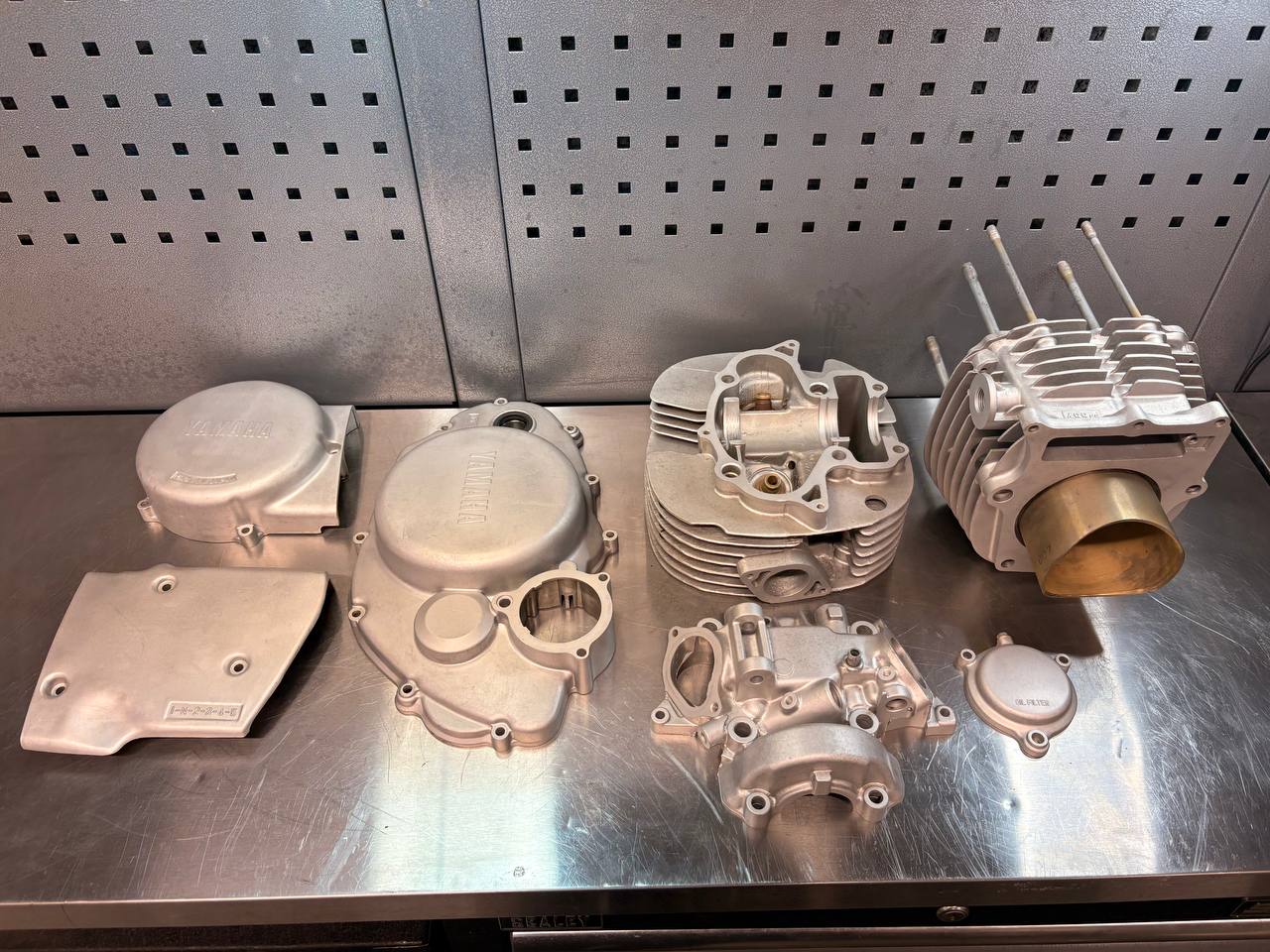
After: the aluminium surfaces have a cleaner, more consistent matte-satin appearance while retaining the original cast texture, branding and contrasting metal features.
The same group of components is shown before and after, although the parts were rearranged and the lighting differs slightly between the photographs. The images demonstrate surface cleaning and visual improvement rather than a mechanically controlled comparison.
Some contrasting liners, studs and inserts remain visible in the photographs. These images do not create a general rule that fitted items can remain. For current jobs, each component must be fully stripped and ready to go straight into the blaster, with anything that fine media could affect removed before acceptance.
The photographs do not prove bearing condition, bore wear, valve condition, tolerances, thread integrity, internal cleanliness or that the engine has been rebuilt. Those require separate inspection, measurement and mechanical work.
Does vapour blasting damage aluminium?
The process is selected to clean the surface while limiting unnecessary abrasive impact, but no abrasive treatment is risk free. Any blasting process must be matched to the component.
Risk can increase when a part is:
- Very thin, delicate or already damaged
- Made from an uncertain material or alloy
- Cracked, heavily corroded or previously repaired
- Dimensionally sensitive
- Fitted with bearings, seals, bushes or other components
- Designed with internal passages or blind cavities
- Dependent on critical machined or sealing surfaces
That is why VMC asks for photographs, dimensions, material information and details of any areas where fine media could cause a problem before quoting.
Can a complete or assembled engine part be vapour blasted?
VMC does not accept an assembled engine or component as ready for blasting. Assemblies may include bearings, seals, bushes, moving parts, oilways, internal cavities or surfaces that could be affected by abrasive media.
Before booking, make sure the part can be supplied as:
- A bare casting
- Fully stripped of bearings, seals, bushes and other vulnerable fitted items
- Free from anything that could trap media or be damaged by it
- Ready to go straight into the blasting cabinet
If an item cannot be removed or fine media could create a problem, show it clearly during the photo assessment. The component may not be suitable for VMC. Do not assume VMC will dismantle fitted components.
Can VMC mask or protect sensitive areas?
VMC cannot rely on masking or securing areas because the blasting media is extremely fine and can travel everywhere. Customers should identify any:
- Threads
- Bearing seats and housings
- Seal-running surfaces
- Gasket and sealing faces
- Precision bores
- Machined faces
- Valve-related surfaces
- Locating features and dowels
- Internal oil or coolant passages
- Identification marks that must remain legible
If media could cause a problem in any of these areas, the part must be stripped or prepared so that it is safe to blast. If that cannot be achieved, VMC may have to decline the component.
What about oilways and internal passages?
Internal passages and blind cavities must be disclosed before blasting. Fine media can travel into openings and cavities, so they can make an apparently simple casting unsuitable where retained media could cause a later problem.
Send photographs of every accessible side and point out known oilways, galleries, drillings or cavities. If the component cannot be supplied fully stripped and ready to blast without media creating a problem, VMC cannot accept it in that condition.
Vapour blasting should never be treated as proof that a mechanical component is internally clean, tested or ready to assemble. Final inspection, mechanical preparation and assembly remain separate responsibilities.
How should I prepare engine parts for a quote?
Before contacting VMC:
- Photograph the whole component. Include all sides and place something alongside it for scale where useful.
- Show the condition. Include close-ups of oxidation, corrosion, paint, grease, cracks or previous repairs.
- State the material. Tell VMC whether it is aluminium or another material if known.
- Give approximate dimensions. Size affects equipment suitability and price.
- Confirm it will be fully stripped. Remove bearings, seals, bushes and anything else that media could affect before the booked job.
- Identify risk areas. Mark threads, faces, bores and internal passages where fine media could cause a problem. VMC cannot rely on masking these areas.
- Describe the required result. Explain whether the aim is restoration appearance, cleaning or preparation for another finish.
- Wait for assessment. Do not post or bring parts to the workshop until suitability and arrangements are confirmed.
See the complete photo guide →
See VMC engine-case blasting →
Bare aluminium, paint or another coating?
Tell VMC what will happen after blasting. A part that will remain as a visible satin casting may need a different conversation from a component that will be painted, coated, assembled into an engine or exposed to road salt and weather.
Paint, corrosion, grease, old coatings and planned aftercare can all affect preparation, price and the recommended process.
What result should I expect?
On a suitable component, vapour blasting can produce a cleaner and more uniform satin appearance. The process does not:
- Fill pits or repair corrosion damage
- Repair cracks, threads or machined surfaces
- Rebuild the component
- Prove internal cleanliness or mechanical condition
- Guarantee that a part is ready to refit
- Make every casting look identical
Casting age, alloy, staining, previous repairs and existing damage can remain visible after cleaning. Realistic assessment begins with clear photographs.
See real VMC before-and-after work →
See a real Triumph crank-case job →
Ask before stripping or sending the part
If you are unsure whether a fitted item or internal passage makes the part unsuitable, send photographs first. The component must be fully stripped and ready to go straight into the blaster. Do not visit or send it until VMC has confirmed that the photographed condition is acceptable.
Pricing depends on size, condition, contamination, stripping state and complexity. Most suitable jobs are typically completed in 1–4 working days, subject to workload and preparation.
Frequently asked questions
Is vapour blasting safe for aluminium engine cases?
It is suitable for many fully stripped aluminium engine cases when the casting, condition, sensitive areas and required finish have been assessed. It is not automatically suitable for every delicate or internally complex component.
Does vapour blasting change dimensions?
Any abrasive process can affect a surface, so VMC should not guarantee zero dimensional effect. Bores, threads, bearing fits, sealing faces and other dimensionally critical areas must be identified before the job is accepted.
Do bearings and seals need to be removed?
Yes. Bearings, seals, bushes and anything else that the media could affect must be removed. The component needs to arrive ready to go straight into the blaster.
Can VMC blast a complete engine?
No. VMC needs components fully stripped and ready to go straight into the blaster. Fine media can travel everywhere, so VMC cannot mask or secure vulnerable internal areas on a complete engine.